Concept · Nacho Muñoz
What is hyperlucidity
I gave this a name because it was happening to me. I understood everything about myself, I could explain it better than anyone, and I was still in exactly the same place. This is what I learned along the way.
Hyperlucidity is a survival strategy we learned as children: turning pain into analysis so we wouldn't have to feel it. It isn't intelligence. It's a very elegant way of not being there.
How to recognize it
You know the exact name of what's happening to you. You know where it comes from, what year it started and what mechanism keeps it going. You can explain it with a clarity that impresses anyone who listens.
And still, when someone really gets close, your body does the same thing it always does. The explanation didn't change anything. It only made it easier to bear.
You can diagnose the cause of the fever perfectly, and you're still burning up with it.
Where it comes from
In almost every case I've seen, and in mine, it starts in a home where understanding fast was the way to make sure nothing caught you by surprise. A child who reads the tone of a door closing, who knows what's going to happen before it happens.
That's not a gift. That's a child who can't afford one more surprise. And the important part: it worked. It saved you back then. The problem comes when at forty you're still using the tool that saved you at nine.
I wasn't a brilliant child. I was a scared child making himself brilliant to survive.
Why understanding doesn't change anything
Explaining looks a lot like moving forward. You move the pieces around, you put a name on it, you congratulate yourself on how clearly you see. And your body, meanwhile, is still in the same place.
That's the trap: understanding becomes a substitute for real transformation. The more sophisticated your analysis, the harder it is to notice that you haven't moved in years.
The more you explain, the less you're in it. The more you analyze, the less you live.
The five forms of mental protection
In the book I call them that because they're five faces of the same thing: anticipation turned into a religion, hyper-responsibility as a form of control, intellectualizing as anesthesia, perfectionism as a shield, and circular analysis as loyalty to the problem.
From the outside they all look like virtues. They all serve the same purpose: not having to feel what's underneath.
What I do with this
I didn't stop understanding. I still understand fast. It's what I know how to do. What changed is that now, when I catch myself explaining something that hurts, I try to stay one more minute before I translate it.
The body lets you know before the head does. Mine lets me know in my breastbone, like a small stone. I didn't learn that by reading. I learned it when I stopped looking for the explanation and my legs shook.
I didn't need to understand it all in order to repair it.
Questions I get asked a lot
- Is hyperlucidity a clinical diagnosis?
- No. It's a name I gave to a pattern that was happening to me and that I see all the time in the people who write to me. It isn't in any diagnostic manual, and it isn't meant to replace a professional.
- What's the difference between understanding and integrating?
- Understanding happens in the head and is usually fast. Integrating happens in the body and is slow: it's noticing where something closes in you when someone gets close, and staying there without running off toward the explanation.
- Is it bad to be very analytical?
- No. Analysis saved you as a child and it's still useful. The problem isn't analyzing. It's analyzing instead of feeling. The useful question isn't whether you think too much, but what you stop feeling while you think.
- So do I have to stop reading about myself?
- You don't have to. I still read. What I changed is the order: first I notice what my body is doing, then I look for the name. When I do it the other way around, the name saves me the work of feeling it.
- Where can I read more about this?
- In The Hyperlucidity Trap, where I tell the whole thing, and on the podcast Diario de un buscador de verdad (in Spanish), where I talk about this with guests and in solo episodes.
Keep going from here
- The Hyperlucidity Trap the book where I tell the whole thing.
- Essays long pieces where I keep thinking this through out loud (in Spanish).
- Diario de un buscador de verdad 52 episodes on this very thing (in Spanish).
- Breathing the first thing I do when I want to come down from my head into my body.
Written by Nacho Muñoz. Updated on 2026-11-18.
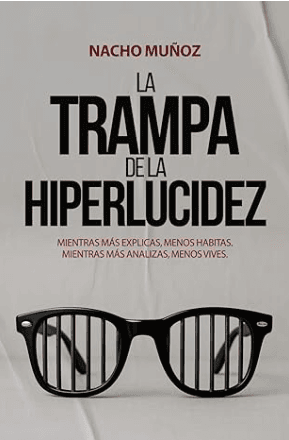
The book
The Hyperlucidity Trap
For people who understand everything and can't change a thing. A confession about those of us who learned to shine so we wouldn't break.
The English edition is on its way.